• Skip to primary navigation
  • Skip to main content
  • Skip to primary sidebar
  • Skip to secondary sidebar
  • About
    • Contact
    • Privacy
    • Terms of use
  • Advertise
    • Advertising
    • Case studies
    • Design
    • Email marketing
    • Features list
    • Lead generation
    • Magazine
    • Press releases
    • Publishing
    • Sponsor an article
    • Webcasting
    • Webinars
    • White papers
    • Writing
  • Subscribe to Newsletter

Robotics & Automation News

Where Innovation Meets Imagination

  • Home
  • News
  • Features
  • Editorial Sections A-Z
    • Agriculture
    • Aircraft
    • Artificial Intelligence
    • Automation
    • Autonomous Vehicles
    • Business
    • Computing
    • Construction
    • Culture
    • Design
    • Drones
    • Economy
    • Energy
    • Engineering
    • Environment
    • Health
    • Humanoids
    • Industrial robots
    • Industry
    • Infrastructure
    • Investments
    • Logistics
    • Manufacturing
    • Marine
    • Material handling
    • Materials
    • Mining
    • Promoted
    • Research
    • Robotics
    • Science
    • Sensors
    • Service robots
    • Software
    • Space
    • Technology
    • Transportation
    • Warehouse robots
    • Wearables
  • Press releases
  • Events

humanoid

Humanoid robots: Stepping out of science fiction, into the real world

December 10, 2024 by Mark Allinson

For many decades, science fiction films and books have described and shown us a variety of humanoid robots that range from ones that look clearly mechanical and follow simple orders and have limited functionality to ones that are indistinguishable from human beings in appearance but are far stronger, faster and more capable in many ways.

And over those decades, audiences have been encouraged to imagine such robots as figments of the imagination, something for the future – a future after our own lifetimes.

Now, however, instead of waiting there for us to die and spare us from having to deal with it, that future is hurtling towards us with unsettling speed.

[Read more…] about Humanoid robots: Stepping out of science fiction, into the real world
Filed Under: Features, Humanoids Tagged With: androids, cyborgs, fiction, humanoid, humanoids, robots, science

RealMan Robotics showcases ‘ultra-lightweight humanoid’ robotic arms

November 22, 2024 by Mark Allinson

RealMan Robotics, a company specializing in the development, production and sales of “ultra-lightweight humanoid robotic arms”, has unveiled its latest robotic arms, joint model and embodied intelligence platforms at Advanced Manufacturing Madrid 2024 in Spain.

At this year’s event, RealMan showcased its ultra-lightweight humanoid robotic arms, including the ECO series, RM series robotic arms, WHJ series joint modules, RealEye Vision Sensing Platform, Embodied Intelligence Dual-Arm Development Platform, Embodied Dual-Arm elevation Platform, as well as AI physiotherapy Robot, among other technologies.

The ECO65, which is suitable for industrial applications, is the most advanced robotic arm in the world, and is designed to be used in a variety of applications. [Read more…] about RealMan Robotics showcases ‘ultra-lightweight humanoid’ robotic arms

Filed Under: Industrial robots, News Tagged With: advanced, arms, humanoid, madrid, manufacturing, realman, robotics, show, spain, trade, ultra-lightweight

The three-computer solution: Powering the next wave of AI robotics

November 5, 2024 by Mark Allinson

By Madison Huang, director of product and technical marketing, Nvidia

Industrial, physical AI-based systems – from humanoids to factories – are being accelerated across training, simulation and inference.

ChatGPT marked the big bang moment of generative AI. Answers can be generated in response to nearly any query, helping transform digital work such as content creation, customer service, software development and business operations for knowledge workers.

Physical AI, the embodiment of artificial intelligence in humanoids, factories and other devices within industrial systems, has yet to experience its breakthrough moment.

This has held back industries such as transportation and mobility, manufacturing, logistics and robotics. But that’s about to change thanks to three computers bringing together advanced training, simulation and inference.

The rise of multimodal, physical AI

For 60 years, “Software 1.0” – serial code written by human programmers – ran on general-purpose computers powered by CPUs.

Then, in 2012, Alex Krizhevsky, mentored by Ilya Sutskever and Geoffrey Hinton, won the ImageNet computer image recognition competition with AlexNet, a revolutionary deep learning model for image classification.

This marked the industry’s first contact with AI. The breakthrough of machine learning – neural networks running on GPUs – jump-started the era of Software 2.0.

Today, software writes software. The world’s computing workloads are shifting from general-purpose computing on CPUs to accelerated computing on GPUs, leaving Moore’s law far behind.

With generative AI, multimodal transformer and diffusion models have been trained to generate responses.

Large language models are one-dimensional, able to predict the next token, in modes like letters or words. Image- and video-generation models are two-dimensional, able to predict the next pixel.

None of these models can understand or interpret the three-dimensional world. And that’s where physical AI comes in.

Physical AI models can perceive, understand, interact with and navigate the physical world with generative AI. With accelerated computing, multimodal physical AI breakthroughs and large-scale physically based simulations are allowing the world to realize the value of physical AI through robots.

A robot is a system that can perceive, reason, plan, act and learn. Robots are often thought of as autonomous mobile robots (AMRs), manipulator arms or humanoids. But there are many more types of robotic embodiments.

In the near future, everything that moves, or that monitors things that move, will be autonomous robotic systems. These systems will be capable of sensing and responding to their environments.

Everything from surgical rooms to data centers, warehouses to factories, even traffic control systems or entire smart cities will transform from static, manually operated systems to autonomous, interactive systems embodied by physical AI.

The next frontier: Humanoids robots

Humanoid robots are an ideal general-purpose robotic manifestation because they can operate efficiently in environments built for humans, while requiring minimal adjustments for deployment and operation.

The global market for humanoid robots is expected to reach $38 billion by 2035, a more than sixfold increase from the roughly $6 billion for the period forecast nearly two years ago, according to Goldman Sachs.

Researchers and developers around the world are racing to build this next wave of robots.

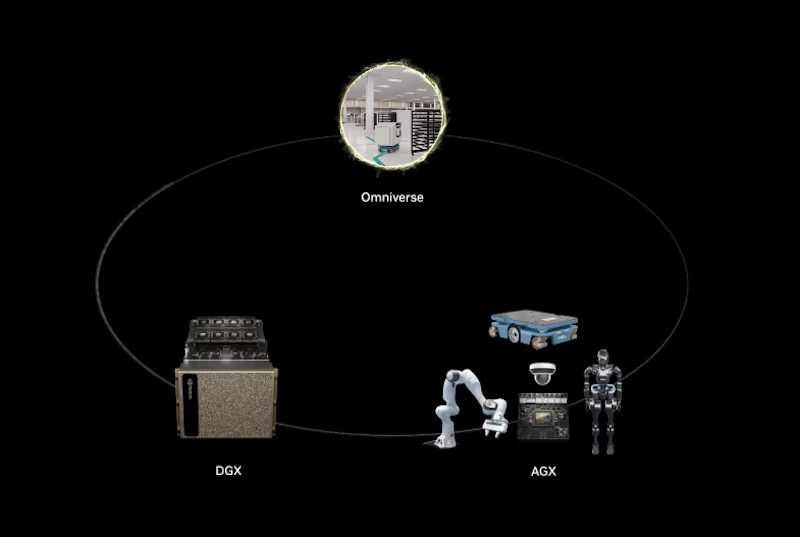
Three computers to develop physical AI

To develop humanoid robots, three accelerated computer systems are required to handle physical AI and robot training, simulation and runtime. Two computing advancements are accelerating humanoid robot development: multimodal foundation models and scalable, physically based simulations of robots and their worlds.

Breakthroughs in generative AI are bringing 3D perception, control, skill planning and intelligence to robots. Robot simulation at scale lets developers refine, test and optimize robot skills in a virtual world that mimics the laws of physics – helping reduce real-world data acquisition costs and ensuring they can perform in safe, controlled settings.

Nvidia has built three computers and accelerated development platforms to enable developers to create physical AI.

First, models are trained on a supercomputer. Developers can use Nvidia NeMo on the Nvidia DGX platform to train and fine-tune powerful foundation and generative AI models.

They can also tap into Nvidia Project GR00T, an initiative to develop general-purpose foundation models for humanoid robots to enable them to understand natural language and emulate movements by observing human actions.

Second, Nvidia Omniverse, running on Nvidia OVX servers, provides the development platform and simulation environment for testing and optimizing physical AI with application programming interfaces and frameworks like Nvidia Isaac Sim.

Developers can use Isaac Sim to simulate and validate robot models, or generate massive amounts of physically-based synthetic data to bootstrap robot model training.

Researchers and developers can also use Nvidia Isaac Lab, an open-source robot learning framework that powers robot reinforcement learning and imitation learning, to help accelerate robot policy training and refinement.

Lastly, trained AI models are deployed to a runtime computer. Nvidia Jetson Thor robotics computers are specifically designed for compact, on-board computing needs.

An ensemble of models consisting of control policy, vision and language models composes the robot brain and is deployed on a power-efficient, on-board edge computing system.

Depending on their workflows and challenge areas, robot makers and foundation model developers can use as many of the accelerated computing platforms and systems as needed.

Building the next wave of autonomous facilities

Robotic facilities result from a culmination of all of these technologies.

Manufacturers like Foxconn or logistics companies like Amazon Robotics can orchestrate teams of autonomous robots to work alongside human workers and monitor factory operations through hundreds or thousands of sensors.

These autonomous warehouses, plants and factories will have digital twins. The digital twins are used for layout planning and optimization, operations simulation and, most importantly, robot fleet software-in-the-loop testing.

Built on Omniverse, “Mega” is a blueprint for factory digital twins that enables industrial enterprises to test and optimize their robot fleets in simulation before deploying them to physical factories. This helps ensure seamless integration, optimal performance and minimal disruption.

Mega lets developers populate their factory digital twins with virtual robots and their AI models, or the brains of the robots.

Robots in the digital twin execute tasks by perceiving their environment, reasoning, planning their next motion and, finally, completing planned actions.

These actions are simulated in the digital environment by the world simulator in Omniverse, and the results are perceived by the robot brains through Omniverse sensor simulation.

With sensor simulations, the robot brains decide the next action, and the loop continues, all while Mega meticulously tracks the state and position of every element within the factory digital twin.

This advanced software-in-the-loop testing methodology enables industrial enterprises to simulate and validate changes within the safe confines of the Omniverse digital twin, helping them anticipate and mitigate potential issues to reduce risk and costs during real-world deployment.

Empowering the developer ecosystem with Nvidia technology

Nvidia accelerates the work of the global ecosystem of robotics developers and robot foundation model builders with three computers.

Universal Robots, a Teradyne Robotics company, used Nvidia Isaac Manipulator, Isaac accelerated libraries and AI models, and Nvidia Jetson Orin to build UR AI Accelerator, a ready-to-use hardware and software toolkit that enables cobot developers to build applications, accelerate development and reduce the time to market of AI products.

RGo Robotics used Nvidia Isaac Perceptor to help its wheel.me AMRs work everywhere, all the time, and make intelligent decisions by giving them human-like perception and visual-spatial information.

Humanoid robot makers including 1X Technologies, Agility Robotics, Apptronik, Boston Dynamics, Fourier, Galbot, Mentee, Sanctuary AI, Unitree Robotics and XPENG Robotics are adopting Nvidia’s robotics development platform.

Boston Dynamics is using Isaac Sim and Isaac Lab to build quadrupeds and humanoid robots to augment human productivity, tackle labor shortages and prioritize safety in warehouses.

Fourier is tapping into Isaac Sim to train humanoid robots to operate in fields that demand high levels of interaction and adaptability, such as scientific research, healthcare and manufacturing.

Using Isaac Lab and Isaac Sim, Galbot advanced the development of a large-scale robotic dexterous grasp dataset called DexGraspNet that can be applied to different dexterous robotic hands, as well as a simulation environment for evaluating dexterous grasping models.

Field AI developed risk-bounded multitask and multipurpose foundation models for robots to safely operate in outdoor field environments, using the Isaac platform and Isaac Lab.

The era of physical AI is here – and it’s transforming the world’s heavy industries and robotics.

Filed Under: Computing, Features Tagged With: ai, autonomous, digital, facilities, factories, humanoid, nvidia, omniverse, robotics, robots, solution, three-computer, twin

Boston Dynamics and Toyota partner to advance humanoid robotics research

October 21, 2024 by Mark Allinson

Boston Dynamics and Toyota Research Institute (TRI) say they are partnering to accelerate the development of artificial intelligence and robotics.

The research partnership aims to accelerate the development of general-purpose humanoid robots utilizing TRI’s Large Behavior Models and Boston Dynamics’ Atlas robot.

Robert Playter, CEO of Boston Dynamics, says: “There has never been a more exciting time for the robotics industry, and we look forward to working with TRI to accelerate the development of general-purpose humanoids. [Read more…] about Boston Dynamics and Toyota partner to advance humanoid robotics research

Filed Under: News, Research Tagged With: atlas, boston, dynamics, global, humanoid, institute, research, robots, toyota

Humanoid robots are a ‘publicity stunt and serve no purpose in automated warehouses’, says Exotec

October 18, 2024 by Mark Allinson

In a blistering critique, established warehouse automation company Exotec says “useless” humanoid robot prototypes are a “publicity stunt and serve no purpose in automated warehouses”, adding that they “discredit the warehouse industry”.

Robotics systems have evolved significantly in the past decade, evolving from prototypes to fully established technologies across a range of industries.

Warehouses are a major area where robots have made a significant impact. While automated robotics systems can now fulfil increasingly complex tasks, humanoid robots are being touted as the next big thing in some quarters. [Read more…] about Humanoid robots are a ‘publicity stunt and serve no purpose in automated warehouses’, says Exotec

Filed Under: Humanoids, News Tagged With: automated, exotec, humanoid, robots, warehouses

Inaugural humanoid robot industry event reflects ‘tremendous amount of interest’

September 26, 2024 by Mark Allinson

The Humanoid Robot Forum, the first event focused exclusively on this growing robotics category, has released its agenda with experts poised to outline the latest advancements, strategies and applications in manufacturing, logistics and daily life.

The forum is being organised by the Association for Advancing Automation, or A3, one of the world’s leading robotics and automation industries associations.

Speakers at this inaugural event, held October 7 in Memphis, Tennessee, will include Melonee Wise of Agility, Jeff Cardenas of Apptronik, Adrian Stoch of GXO, Huan Tan of UBTECH, Brendan Schulman of Boston Dynamics and Aaron Prather of ASTM International along with other visionaries from Collaborative Robotics, HaptX, NEURA Robotics, Persona AI, Reflex Robotics, Stokes Educational Services, Synapticon and WiBotics. [Read more…] about Inaugural humanoid robot industry event reflects ‘tremendous amount of interest’

Filed Under: Humanoids, News Tagged With: a3, association for advancing automation, event, forum, humanoid, inaugural, industry

GXO partners with Reflex Robotics to install humanoid robots in warehouse

September 20, 2024 by Mark Allinson

GXO Logistics, a pure-play contract logistics provider, has reached a new agreement with Reflex Robotics, a startup company producing humanoid robots, to pilot Reflex’s robotics solution for deployment into live operations. This is GXO’s second Robots-as-a-Service (RaaS) agreement.

The Reflex Robot is an out-of-the-box solution that reaches operational capability within 60 minutes of deployment and ramps to become fully autonomous by learning from human demonstrations over time.

The multi-purpose humanoid from Reflex can transition seamlessly between repetitive tasks, from tote transfers between other kinds of automation to product picking.

[Read more…] about GXO partners with Reflex Robotics to install humanoid robots in warehouse

Filed Under: Humanoids, News Tagged With: gxo, humanoid, logistics, reflex robotics, warehouse

Deep Robotics presents its first humanoid robot and showcases new quadruped robot

September 11, 2024 by Mark Allinson

Deep Robotics, a leading embodied AI and robotics company, unveiled its inaugural humanoid robot model the Dr.01 at the World Robot Conference that opened in Beijing, marking the startup’s efforts to diversify from quadrupedal robotics into the thriving humanoid robotics space.

During the five-day event, which runs through August 25, Hangzhou-based Deep Robotics also demonstrates a series of capabilities of its Embodied AI-powered quadrupedal robot.

Through AI and big data training, future humanoid robots are expected to assist humans in performing repetitive, high-precision tasks, safeguard personnel safety in hazardous environments, enhance human productivity in industrial settings, and improve the quality of life at home.

[Read more…] about Deep Robotics presents its first humanoid robot and showcases new quadruped robot

Filed Under: Humanoids, News Tagged With: ai, beijing, deep robotics, humanoid, quadruped, robot, robotics

How robots are transforming the construction industry

September 9, 2024 by Mark Allinson

Discover how robots are revolutionizing the construction industry by enhancing efficiency, safety, and precision. Article contributed by Cyngn

In 2022, the global construction robotics market was valued at $168.2 million and is expected to reach an impressive $774.6 million by 2032.

[Read more…] about How robots are transforming the construction industry

Filed Under: Construction, Features Tagged With: ai, articulated, automation, BIM, bricklaying, collaborative, construction, cyngn, drones, humanoid, industry, information, labor, laborer, machine, mining, modeling, offsite, prefabrication, robotics, robots, shortages, teleoperated, vehicles

The Impact of AI and Robotics on Advancing Mental Health Care

September 2, 2024 by Mark Allinson

From finance and law to farming and construction, technology is changing everything, and healthcare is no exception. Perhaps more than any other branch of medicine, the field of mental health care has benefitted massively from the advent of the internet, AI, and robotics.

Once upon a time, studying psychology meant attending physical classes; now, the next generation of counselors can enroll in an online Masters in Education Counseling. But that’s just the beginning. [Read more…] about The Impact of AI and Robotics on Advancing Mental Health Care

Filed Under: Health Tagged With: ai, care, education, humanoid, literature, mental, psychologist, robot assisted therapy, robotics, robots, study

  • « Go to Previous Page
  • Page 1
  • Page 2
  • Page 3
  • Page 4
  • Page 5
  • Page 6
  • Interim pages omitted …
  • Page 10
  • Go to Next Page »

Primary Sidebar

Search this website

Latest articles

  • Construction and demolition robots: Building the future
  • Robotics Rising: What Hiring Trends Reveal About Automation Careers
  • Xpanner launches ‘first’ scalable physical AI-based automation solution for construction sites
  • Skelex starts exoskeleton pilot in greenhouses in the Netherlands
  • Humanoid Global makes ‘software investment’ in RideScan
  • $50 million funding sparks ‘manufacturing technology breakthroughs‘ in Ontario
  • Wachendorff expands range of IO-Link encoders
  • Robotics survey highlights autonomy, digital twins, humanoids and ethics as key 2025 trends
  • ABB to implement gearless mill drive service program at Codelco copper mines in Chile
  • Systraplan unveils new automatic tread booking systems for tyre manufacturing

Secondary Sidebar

Copyright © 2026 · News Pro on Genesis Framework · WordPress · Log in

We use cookies on our website to give you the most relevant experience by remembering your preferences and repeat visits. By clicking “Accept”, you consent to the use of ALL the cookies.
Do not sell my personal information.
Cookie SettingsAccept
Manage consent

Privacy Overview

This website uses cookies to improve your experience while you navigate through the website. Out of these, the cookies that are categorized as necessary are stored on your browser as they are essential for the working of basic functionalities of the website. We also use third-party cookies that help us analyze and understand how you use this website. These cookies will be stored in your browser only with your consent. You also have the option to opt-out of these cookies. But opting out of some of these cookies may affect your browsing experience.
Necessary
Always Enabled
Necessary cookies are absolutely essential for the website to function properly. These cookies ensure basic functionalities and security features of the website, anonymously.
CookieDurationDescription
cookielawinfo-checkbox-analytics11 monthsThis cookie is set by GDPR Cookie Consent plugin. The cookie is used to store the user consent for the cookies in the category "Analytics".
cookielawinfo-checkbox-functional11 monthsThe cookie is set by GDPR cookie consent to record the user consent for the cookies in the category "Functional".
cookielawinfo-checkbox-necessary11 monthsThis cookie is set by GDPR Cookie Consent plugin. The cookies is used to store the user consent for the cookies in the category "Necessary".
cookielawinfo-checkbox-others11 monthsThis cookie is set by GDPR Cookie Consent plugin. The cookie is used to store the user consent for the cookies in the category "Other.
cookielawinfo-checkbox-performance11 monthsThis cookie is set by GDPR Cookie Consent plugin. The cookie is used to store the user consent for the cookies in the category "Performance".
viewed_cookie_policy11 monthsThe cookie is set by the GDPR Cookie Consent plugin and is used to store whether or not user has consented to the use of cookies. It does not store any personal data.
Functional
Functional cookies help to perform certain functionalities like sharing the content of the website on social media platforms, collect feedbacks, and other third-party features.
Performance
Performance cookies are used to understand and analyze the key performance indexes of the website which helps in delivering a better user experience for the visitors.
Analytics
Analytical cookies are used to understand how visitors interact with the website. These cookies help provide information on metrics the number of visitors, bounce rate, traffic source, etc.
Advertisement
Advertisement cookies are used to provide visitors with relevant ads and marketing campaigns. These cookies track visitors across websites and collect information to provide customized ads.
Others
Other uncategorized cookies are those that are being analyzed and have not been classified into a category as yet.
SAVE & ACCEPT