• Skip to primary navigation
  • Skip to main content
  • Skip to primary sidebar
  • Skip to secondary sidebar
  • About
    • Contact
    • Privacy
    • Terms of use
  • Advertise
    • Advertising
    • Case studies
    • Design
    • Email marketing
    • Features list
    • Lead generation
    • Magazine
    • Press releases
    • Publishing
    • Sponsor an article
    • Webcasting
    • Webinars
    • White papers
    • Writing
  • Subscribe to Newsletter

Robotics & Automation News

Where Innovation Meets Imagination

  • Home
  • News
  • Features
  • Editorial Sections A-Z
    • Agriculture
    • Aircraft
    • Artificial Intelligence
    • Automation
    • Autonomous Vehicles
    • Business
    • Computing
    • Construction
    • Culture
    • Design
    • Drones
    • Economy
    • Energy
    • Engineering
    • Environment
    • Health
    • Humanoids
    • Industrial robots
    • Industry
    • Infrastructure
    • Investments
    • Logistics
    • Manufacturing
    • Marine
    • Material handling
    • Materials
    • Mining
    • Promoted
    • Research
    • Robotics
    • Science
    • Sensors
    • Service robots
    • Software
    • Space
    • Technology
    • Transportation
    • Warehouse robots
    • Wearables
  • Press releases
  • Events

Computing

How to Effortlessly Manage IT Assets with the Right Tools?

December 20, 2024 by David Edwards

Even an average person, let alone an entrepreneur or a specialist, heavily relies on several digital tools. Sure, there’s a tool or two that you use regularly, but for a lot of them, subscriptions may be quite complex.

While some subscriptions are made monthly, others require paying for a quarter or a full year upfront. Even if they don’t require it, they might incentivize you by offering you a significantly better deal.

So, you paid last fall, but did you pay in October or November? If this happened a year ago, chances are that you just don’t know. [Read more…] about How to Effortlessly Manage IT Assets with the Right Tools?

Filed Under: Computing Tagged With: assets, digital, effortlessly, it, manage, management, right, tools

Security Breaches: Everything You Need to Secure Documents

December 11, 2024 by Mark Allinson

Protecting your documents is a fundamental part of maintaining control over sensitive information. Security breaches can strike anyone, leaving devastating consequences for businesses and individuals alike. Understanding the risks, leveraging secure tools, and adopting best practices can make all the difference.

Every file you handle represents a potential vulnerability – financial reports, legal contracts, or personal records. Their security is about compliance, preserving trust, and preventing catastrophic losses. Without proper safeguards, sensitive data can fall into the wrong hands, leading to irreversible damage.

Understanding the Threats to Document Security

Cybercriminals target your documents to exploit valuable information. To protect them, you need to understand the risks you face and how they evolve.

These threats constantly adapt, leveraging sophisticated tools and methods to bypass traditional defenses. Staying informed about emerging tactics and vulnerabilities empowers preemptive action and effectively fortifies document security measures.

Common Security Breaches

Hackers often exploit weak access controls, unencrypted data, and poorly secured sharing methods. Incorporating remote video surveillance systems can serve as your first layer of physical security, helping you monitor and secure physical access points that might compromise digital security.

Phishing attacks trick you into handing over login credentials, while malware can infiltrate your system to steal or corrupt files. Ransomware attacks are insidious, encrypting your files and demanding payment for their release. Even physical theft of devices can expose sensitive documents.

Human error also plays a significant role in document breaches. Misplacing a device, using weak passwords, or accidentally sharing a file with the wrong recipient can lead to unintended exposure.

These vulnerabilities highlight the importance of vigilance and proactive measures to prevent such mistakes from becoming costly breaches.

High-Stakes Consequences

A single breach can result in financial losses, legal liabilities, and damage to your reputation. For businesses, the fallout might include regulatory penalties, loss of client trust, and operational disruptions.

Personal breaches, on the other hand, can lead to identity theft, financial fraud, and emotional distress. By recognizing these stakes, you can prioritize document security as a critical component of your overall protection strategy, ensuring that every file – no matter how minor it may seem – is safeguarded.

The Role of Encryption in Document Security

Encryption transforms your files into unreadable code, ensuring only authorized parties can access them. When you encrypt a document, you apply a mathematical algorithm to scramble its contents.

Only someone with the correct decryption key can unlock and read the file. This means that even if hackers intercept your data, they won’t be able to use it. Encryption adds a crucial layer of defense during transmission, making it vital for secure communication.

Modern encryption standards like AES-256 provide robust protection. Always ensure the tools you use meet industry standards for encryption, as outdated methods can be easily compromised. Encryption should be treated as a non-negotiable aspect of document security.

Implementing Encryption Across Platforms

Encrypt documents both in transit and at rest – for example, when sharing a file via email or a cloud service, ensure the platform uses end-to-end encryption.

For stored files, encrypt sensitive folders on your hard drive or external storage devices. Most operating systems offer built-in encryption options, which are easy to activate and highly effective.

Encryption tools are now widely accessible, making it easier than ever to integrate them into your daily workflow. Whether you’re working from a local computer or leveraging cloud-based solutions, encryption serves as a foundational element in your security strategy.

Choosing Secure Document Management Tools

Opt for tools with strong authentication methods, such as multi-factor authentication (MFA). This adds an extra layer of security, requiring a second verification step beyond just a password. Look for platforms that offer access control features, allowing you to specify who can view, edit, or share documents.

Audit trails are another critical feature. They help you track changes, view sharing activity, and identify any suspicious behavior.

Get detailed insights into how documents are accessed and interacted with using a react pdf viewer to further enhance this process by ensuring a more comprehensive approach to security.

With real-time alerts, you can respond to potential threats immediately, minimizing damage, with added transparency and accountability.

Trusted Solutions

Reputable tools like cloud-based document management systems often combine encryption, access controls, and auditing features in one package. Before committing to a platform, review its security certifications and customer reviews. A well-vetted solution can save you from vulnerabilities and provide peace of mind.

Additionally, some platforms offer advanced features such as digital watermarking and automated backups, further reducing your risk of losing or exposing critical files. Investing in high-quality tools is a small price to pay compared to the potential cost of a breach.

Best Practices for Secure Document Handling

Even the best tools can fall short if you don’t use them correctly. Every account or tool you use should have a unique, complex password.

Avoid reusing passwords across multiple platforms, as this increases your vulnerability to attacks. Using a password manager simplifies this process and ensures you’re not relying on memory alone.

Access control should extend beyond passwords. Limit file access to only those who genuinely need it. For highly sensitive documents, consider setting expiry dates on shared links or applying watermarking to prevent unauthorized distribution.

Access permissions should be regularly reviewed and updated to maintain tight security.

Regular Updates and Monitoring

Developers frequently release patches to fix security flaws, and ignoring updates can leave your documents exposed. Regularly monitor your document-sharing activities and audit access logs to spot any unusual behavior.

Conducting regular training for anyone who handles documents in your organization can also reduce risks. Teaching best practices for secure handling ensures everyone is aligned on the importance of document security.

Responding to Document Security Breaches

Despite your best efforts, breaches can occur. Knowing how to respond effectively can mitigate the damage and restore security quickly. Having an incident response plan can streamline your actions, ensuring that every critical step is taken without delay.

Additionally, maintaining detailed documentation of the breach helps identify its root cause and prevents similar incidents in the future. If you suspect a breach, act swiftly.

Disconnect the affected device from your network to prevent further data loss.

Identify the compromised documents and assess the potential impact.

Notify any affected parties, whether they are clients, colleagues, or other stakeholders.

Additionally, reset passwords and revoke access for any accounts linked to the breach. This limits the attacker’s ability to cause additional harm.

If necessary, involve cybersecurity professionals to investigate and resolve the issue. Their expertise can uncover hidden vulnerabilities and provide a clearer picture of the breach’s scope.

Long-Term Recovery

After a breach, review your security measures and identify the gaps that allowed the incident to occur. Implement stronger controls and educate yourself and your team on updated best practices. Learn from the breach to build a more resilient system moving forward.

Long-term strategies include investing in advanced monitoring tools, strengthening your incident response plan, and conducting regular security audits. These measures help ensure you’re better prepared for future threats and can respond more effectively if they arise.

Conclusion

Understanding the threats, adopting encryption, and using secure platforms minimize your risk of falling victim to security breaches. Taking these steps safeguards trust and ensures continuity in your personal and professional life.

Treat document security as a priority, and you’ll be able to prevent your vulnerable information from becoming a potential target.

The right strategies and tools will make document security an easily manageable task. The peace of mind from knowing your sensitive information is safe is well worth the effort, enabling you to focus on what truly matters in your work and life.

Filed Under: Computing Tagged With: breaches, documents, react, secure, security, sensitive, threats, viewer

Siemens and Microsoft scale industrial AI

November 29, 2024 by Mark Allinson

Siemens says it is “revolutionizing” industrial automation with Microsoft. Through their collaboration, they have taken the Siemens Industrial Copilot to “the next level”, enabling it to handle the most demanding environments at scale.

Combining Siemens’ unique domain know-how across industries with Microsoft Azure OpenAI Service, the Copilot further improves handling of rigorous requirements in manufacturing and automation.

Over 100 companies, including Schaeffler and thyssenkrupp Automation Engineering, are currently using the Siemens Industrial Copilot to streamline processes, address labor shortages, and drive innovation. [Read more…] about Siemens and Microsoft scale industrial AI

Filed Under: Computing, News Tagged With: automation, cloud, industrial, microsoft, siemens

Honeywell and Google Cloud to accelerate autonomous operations with AI agents for the industrial sector

November 29, 2024 by Mark Allinson

Honeywell and Google Cloud are partnering to launch a “unique collaboration” connecting artificial intelligence (AI) agents with assets, people and processes to accelerate safer, autonomous operations for the industrial sector.

This partnership will bring together the multimodality and natural language capabilities of Gemini on Vertex AI – Google Cloud’s AI platform – and the massive data set on Honeywell Forge, a leading Internet of Things (IoT) platform for industrials.

This will unleash easy-to-understand, enterprise-wide insights across a multitude of use cases. Honeywell’s customers across the industrial sector will benefit from opportunities to reduce maintenance costs, increase operational productivity and upskill employees. [Read more…] about Honeywell and Google Cloud to accelerate autonomous operations with AI agents for the industrial sector

Filed Under: Computing, News Tagged With: agents, ai, artificial, autonomous, edge, google, honeywell, industrial, intelligence

The Dark Side of Bad SaaS Design

November 28, 2024 by Mark Allinson

The development of digital technologies has radically changed approaches to business process organization. Cloud solutions and software as a service (SaaS) have become integral parts of the working ecosystems of companies of various sizes and profiles.

Interface quality is becoming a key factor of product success in the context of fierce competition and ever-increasing user expectations. Bad SaaS design can become a critical barrier between user and functionality, turning even the most innovative solutions into a source of constant stress and loss of productivity. 

User experience determines a product’s usability and overall perceived value. The slightest UX miscalculations can instantly reduce user loyalty and lead to customer churn.

[Read more…] about The Dark Side of Bad SaaS Design

Filed Under: Computing Tagged With: anti-patterns, complexity, dark, elements, interface, modal, navigational, notifications, optimal, principles, SaaS, security, software, software-as-a-service, windows

The Ultimate Guide to Access Control Systems

November 24, 2024 by Mark Allinson

Security is a paramount concern for businesses and residential properties alike. Access control systems provide a reliable solution for securing premises and managing the flow of people. Understanding the intricacies of these systems is crucial for anyone looking to enhance their security infrastructure.

In this article, we will delve into the various aspects of access control, including definitions, components, technologies, and maintenance strategies to ensure optimal performance.

[Read more…] about The Ultimate Guide to Access Control Systems

Filed Under: Computing Tagged With: access, control, guide, infrastructure, measures, security, systems

PHP Developer vs. Java Developer: Who is Better in Web Development?

November 15, 2024 by Mark Allinson

In the world of software development, there are countless prevalent options for programming languages.

Each language offers its strengths and weaknesses, and their popularity and usage can alter depending on the needs of the project. Two programming languages that are often compared are PHP and Java.

While Java is an all-time classic and one of the best languages for beginners, PHP is widely known as a relatively newer language. They differ on many fronts.

[Read more…] about PHP Developer vs. Java Developer: Who is Better in Web Development?

Filed Under: Computing Tagged With: best, better, developer, developers, development, environment, html, java, language, languages, php, programming, web

Google Cloud and ‘major manufacturers’ join OPC Foundation initiative

November 12, 2024 by Mark Allinson

Google Cloud has become one of the “who’s who of cloud suppliers and world-famous manufacturers” that have joined the OPC’s newly launched Cloud Initiative, according to the OPC Foundation.

OPC, also known as the OPC Unified Architecture (OPC UA), is a machine-to-machine communication protocol used for industrial automation and developed by the OPC Foundation.

The OPC says the new members are looking to align
interoperability requirements in IT and cloud environments based on OPC UA. [Read more…] about Google Cloud and ‘major manufacturers’ join OPC Foundation initiative

Filed Under: Computing, News Tagged With: architecture, cloud, communication, data, foundation, google, it, machine-to-machine, manufacturers, opc, opc ua, suppliers, unified

The three-computer solution: Powering the next wave of AI robotics

November 5, 2024 by Mark Allinson

By Madison Huang, director of product and technical marketing, Nvidia

Industrial, physical AI-based systems – from humanoids to factories – are being accelerated across training, simulation and inference.

ChatGPT marked the big bang moment of generative AI. Answers can be generated in response to nearly any query, helping transform digital work such as content creation, customer service, software development and business operations for knowledge workers.

Physical AI, the embodiment of artificial intelligence in humanoids, factories and other devices within industrial systems, has yet to experience its breakthrough moment.

This has held back industries such as transportation and mobility, manufacturing, logistics and robotics. But that’s about to change thanks to three computers bringing together advanced training, simulation and inference.

The rise of multimodal, physical AI

For 60 years, “Software 1.0” – serial code written by human programmers – ran on general-purpose computers powered by CPUs.

Then, in 2012, Alex Krizhevsky, mentored by Ilya Sutskever and Geoffrey Hinton, won the ImageNet computer image recognition competition with AlexNet, a revolutionary deep learning model for image classification.

This marked the industry’s first contact with AI. The breakthrough of machine learning – neural networks running on GPUs – jump-started the era of Software 2.0.

Today, software writes software. The world’s computing workloads are shifting from general-purpose computing on CPUs to accelerated computing on GPUs, leaving Moore’s law far behind.

With generative AI, multimodal transformer and diffusion models have been trained to generate responses.

Large language models are one-dimensional, able to predict the next token, in modes like letters or words. Image- and video-generation models are two-dimensional, able to predict the next pixel.

None of these models can understand or interpret the three-dimensional world. And that’s where physical AI comes in.

Physical AI models can perceive, understand, interact with and navigate the physical world with generative AI. With accelerated computing, multimodal physical AI breakthroughs and large-scale physically based simulations are allowing the world to realize the value of physical AI through robots.

A robot is a system that can perceive, reason, plan, act and learn. Robots are often thought of as autonomous mobile robots (AMRs), manipulator arms or humanoids. But there are many more types of robotic embodiments.

In the near future, everything that moves, or that monitors things that move, will be autonomous robotic systems. These systems will be capable of sensing and responding to their environments.

Everything from surgical rooms to data centers, warehouses to factories, even traffic control systems or entire smart cities will transform from static, manually operated systems to autonomous, interactive systems embodied by physical AI.

The next frontier: Humanoids robots

Humanoid robots are an ideal general-purpose robotic manifestation because they can operate efficiently in environments built for humans, while requiring minimal adjustments for deployment and operation.

The global market for humanoid robots is expected to reach $38 billion by 2035, a more than sixfold increase from the roughly $6 billion for the period forecast nearly two years ago, according to Goldman Sachs.

Researchers and developers around the world are racing to build this next wave of robots.

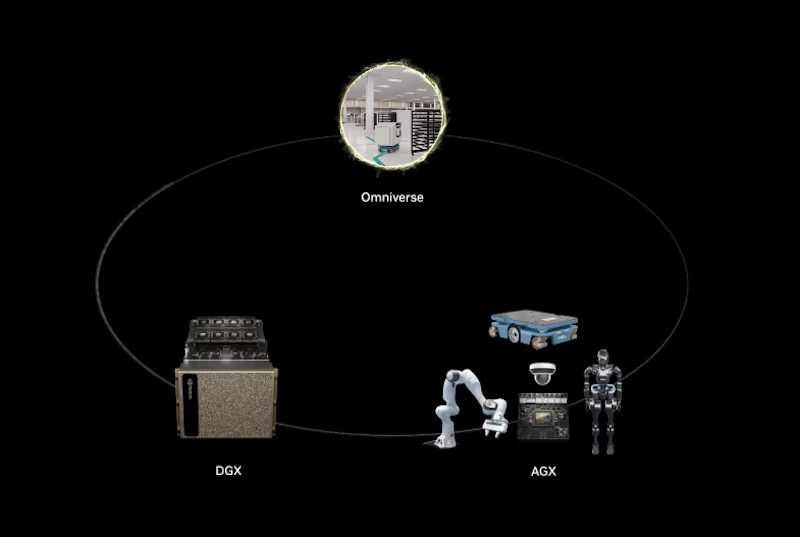
Three computers to develop physical AI

To develop humanoid robots, three accelerated computer systems are required to handle physical AI and robot training, simulation and runtime. Two computing advancements are accelerating humanoid robot development: multimodal foundation models and scalable, physically based simulations of robots and their worlds.

Breakthroughs in generative AI are bringing 3D perception, control, skill planning and intelligence to robots. Robot simulation at scale lets developers refine, test and optimize robot skills in a virtual world that mimics the laws of physics – helping reduce real-world data acquisition costs and ensuring they can perform in safe, controlled settings.

Nvidia has built three computers and accelerated development platforms to enable developers to create physical AI.

First, models are trained on a supercomputer. Developers can use Nvidia NeMo on the Nvidia DGX platform to train and fine-tune powerful foundation and generative AI models.

They can also tap into Nvidia Project GR00T, an initiative to develop general-purpose foundation models for humanoid robots to enable them to understand natural language and emulate movements by observing human actions.

Second, Nvidia Omniverse, running on Nvidia OVX servers, provides the development platform and simulation environment for testing and optimizing physical AI with application programming interfaces and frameworks like Nvidia Isaac Sim.

Developers can use Isaac Sim to simulate and validate robot models, or generate massive amounts of physically-based synthetic data to bootstrap robot model training.

Researchers and developers can also use Nvidia Isaac Lab, an open-source robot learning framework that powers robot reinforcement learning and imitation learning, to help accelerate robot policy training and refinement.

Lastly, trained AI models are deployed to a runtime computer. Nvidia Jetson Thor robotics computers are specifically designed for compact, on-board computing needs.

An ensemble of models consisting of control policy, vision and language models composes the robot brain and is deployed on a power-efficient, on-board edge computing system.

Depending on their workflows and challenge areas, robot makers and foundation model developers can use as many of the accelerated computing platforms and systems as needed.

Building the next wave of autonomous facilities

Robotic facilities result from a culmination of all of these technologies.

Manufacturers like Foxconn or logistics companies like Amazon Robotics can orchestrate teams of autonomous robots to work alongside human workers and monitor factory operations through hundreds or thousands of sensors.

These autonomous warehouses, plants and factories will have digital twins. The digital twins are used for layout planning and optimization, operations simulation and, most importantly, robot fleet software-in-the-loop testing.

Built on Omniverse, “Mega” is a blueprint for factory digital twins that enables industrial enterprises to test and optimize their robot fleets in simulation before deploying them to physical factories. This helps ensure seamless integration, optimal performance and minimal disruption.

Mega lets developers populate their factory digital twins with virtual robots and their AI models, or the brains of the robots.

Robots in the digital twin execute tasks by perceiving their environment, reasoning, planning their next motion and, finally, completing planned actions.

These actions are simulated in the digital environment by the world simulator in Omniverse, and the results are perceived by the robot brains through Omniverse sensor simulation.

With sensor simulations, the robot brains decide the next action, and the loop continues, all while Mega meticulously tracks the state and position of every element within the factory digital twin.

This advanced software-in-the-loop testing methodology enables industrial enterprises to simulate and validate changes within the safe confines of the Omniverse digital twin, helping them anticipate and mitigate potential issues to reduce risk and costs during real-world deployment.

Empowering the developer ecosystem with Nvidia technology

Nvidia accelerates the work of the global ecosystem of robotics developers and robot foundation model builders with three computers.

Universal Robots, a Teradyne Robotics company, used Nvidia Isaac Manipulator, Isaac accelerated libraries and AI models, and Nvidia Jetson Orin to build UR AI Accelerator, a ready-to-use hardware and software toolkit that enables cobot developers to build applications, accelerate development and reduce the time to market of AI products.

RGo Robotics used Nvidia Isaac Perceptor to help its wheel.me AMRs work everywhere, all the time, and make intelligent decisions by giving them human-like perception and visual-spatial information.

Humanoid robot makers including 1X Technologies, Agility Robotics, Apptronik, Boston Dynamics, Fourier, Galbot, Mentee, Sanctuary AI, Unitree Robotics and XPENG Robotics are adopting Nvidia’s robotics development platform.

Boston Dynamics is using Isaac Sim and Isaac Lab to build quadrupeds and humanoid robots to augment human productivity, tackle labor shortages and prioritize safety in warehouses.

Fourier is tapping into Isaac Sim to train humanoid robots to operate in fields that demand high levels of interaction and adaptability, such as scientific research, healthcare and manufacturing.

Using Isaac Lab and Isaac Sim, Galbot advanced the development of a large-scale robotic dexterous grasp dataset called DexGraspNet that can be applied to different dexterous robotic hands, as well as a simulation environment for evaluating dexterous grasping models.

Field AI developed risk-bounded multitask and multipurpose foundation models for robots to safely operate in outdoor field environments, using the Isaac platform and Isaac Lab.

The era of physical AI is here – and it’s transforming the world’s heavy industries and robotics.

Filed Under: Computing, Features Tagged With: ai, autonomous, digital, facilities, factories, humanoid, nvidia, omniverse, robotics, robots, solution, three-computer, twin

Boost Auto-Trading Efficiency: Running MetaTrader on a VPS – a Complete Guide

November 4, 2024 by Mark Allinson

In the fast-paced world of trading, every millisecond counts. Running MetaTrader on a Virtual Private Server (VPS) ensures your trading strategies are executed with lightning speed and precision.

By hosting your MetaTrader platform on a forex VPS, you gain a stable, low-latency environment that keeps your automated strategies running 24/7 without interruptions. This setup is perfect for traders aiming to minimize downtime and maximize efficiency.

Imagine executing market orders swiftly, thanks to your VPS’s proximity to major forex brokers and financial institutions. With a VPS, your trading isn’t tied to your personal computer, allowing you to manage and automate trades from anywhere using any internet-enabled device. [Read more…] about Boost Auto-Trading Efficiency: Running MetaTrader on a VPS – a Complete Guide

Filed Under: Computing Tagged With: auto-trading, efficiency, hosting, metatrader, server, virtual, vps

  • « Go to Previous Page
  • Page 1
  • Interim pages omitted …
  • Page 4
  • Page 5
  • Page 6
  • Page 7
  • Page 8
  • Interim pages omitted …
  • Page 103
  • Go to Next Page »

Primary Sidebar

Search this website

Latest articles

  • Construction and demolition robots: Building the future
  • Robotics Rising: What Hiring Trends Reveal About Automation Careers
  • Xpanner launches ‘first’ scalable physical AI-based automation solution for construction sites
  • Skelex starts exoskeleton pilot in greenhouses in the Netherlands
  • Humanoid Global makes ‘software investment’ in RideScan
  • $50 million funding sparks ‘manufacturing technology breakthroughs‘ in Ontario
  • Wachendorff expands range of IO-Link encoders
  • Robotics survey highlights autonomy, digital twins, humanoids and ethics as key 2025 trends
  • ABB to implement gearless mill drive service program at Codelco copper mines in Chile
  • Systraplan unveils new automatic tread booking systems for tyre manufacturing

Secondary Sidebar

Copyright © 2026 · News Pro on Genesis Framework · WordPress · Log in

We use cookies on our website to give you the most relevant experience by remembering your preferences and repeat visits. By clicking “Accept”, you consent to the use of ALL the cookies.
Do not sell my personal information.
Cookie SettingsAccept
Manage consent

Privacy Overview

This website uses cookies to improve your experience while you navigate through the website. Out of these, the cookies that are categorized as necessary are stored on your browser as they are essential for the working of basic functionalities of the website. We also use third-party cookies that help us analyze and understand how you use this website. These cookies will be stored in your browser only with your consent. You also have the option to opt-out of these cookies. But opting out of some of these cookies may affect your browsing experience.
Necessary
Always Enabled
Necessary cookies are absolutely essential for the website to function properly. These cookies ensure basic functionalities and security features of the website, anonymously.
CookieDurationDescription
cookielawinfo-checkbox-analytics11 monthsThis cookie is set by GDPR Cookie Consent plugin. The cookie is used to store the user consent for the cookies in the category "Analytics".
cookielawinfo-checkbox-functional11 monthsThe cookie is set by GDPR cookie consent to record the user consent for the cookies in the category "Functional".
cookielawinfo-checkbox-necessary11 monthsThis cookie is set by GDPR Cookie Consent plugin. The cookies is used to store the user consent for the cookies in the category "Necessary".
cookielawinfo-checkbox-others11 monthsThis cookie is set by GDPR Cookie Consent plugin. The cookie is used to store the user consent for the cookies in the category "Other.
cookielawinfo-checkbox-performance11 monthsThis cookie is set by GDPR Cookie Consent plugin. The cookie is used to store the user consent for the cookies in the category "Performance".
viewed_cookie_policy11 monthsThe cookie is set by the GDPR Cookie Consent plugin and is used to store whether or not user has consented to the use of cookies. It does not store any personal data.
Functional
Functional cookies help to perform certain functionalities like sharing the content of the website on social media platforms, collect feedbacks, and other third-party features.
Performance
Performance cookies are used to understand and analyze the key performance indexes of the website which helps in delivering a better user experience for the visitors.
Analytics
Analytical cookies are used to understand how visitors interact with the website. These cookies help provide information on metrics the number of visitors, bounce rate, traffic source, etc.
Advertisement
Advertisement cookies are used to provide visitors with relevant ads and marketing campaigns. These cookies track visitors across websites and collect information to provide customized ads.
Others
Other uncategorized cookies are those that are being analyzed and have not been classified into a category as yet.
SAVE & ACCEPT